
Buying Building Materials Has Always Been a Challenge
Choosing exterior materials for a home or commercial project is one of the most important decisions in construction. The right material can transform a building’s appearance, while the wrong choice can lead to disappointment, additional expenses, and costly replacements.
Traditionally, customers selected HPL sheets by looking at small physical samples, printed catalogs, or showroom displays. While these methods provide some understanding of color and texture, they often fail to answer one critical question:
“How will this design actually look on my building?”
This challenge has led to the rise of one of the most exciting innovations in the construction industry—3D Augmented Reality (AR) technology.
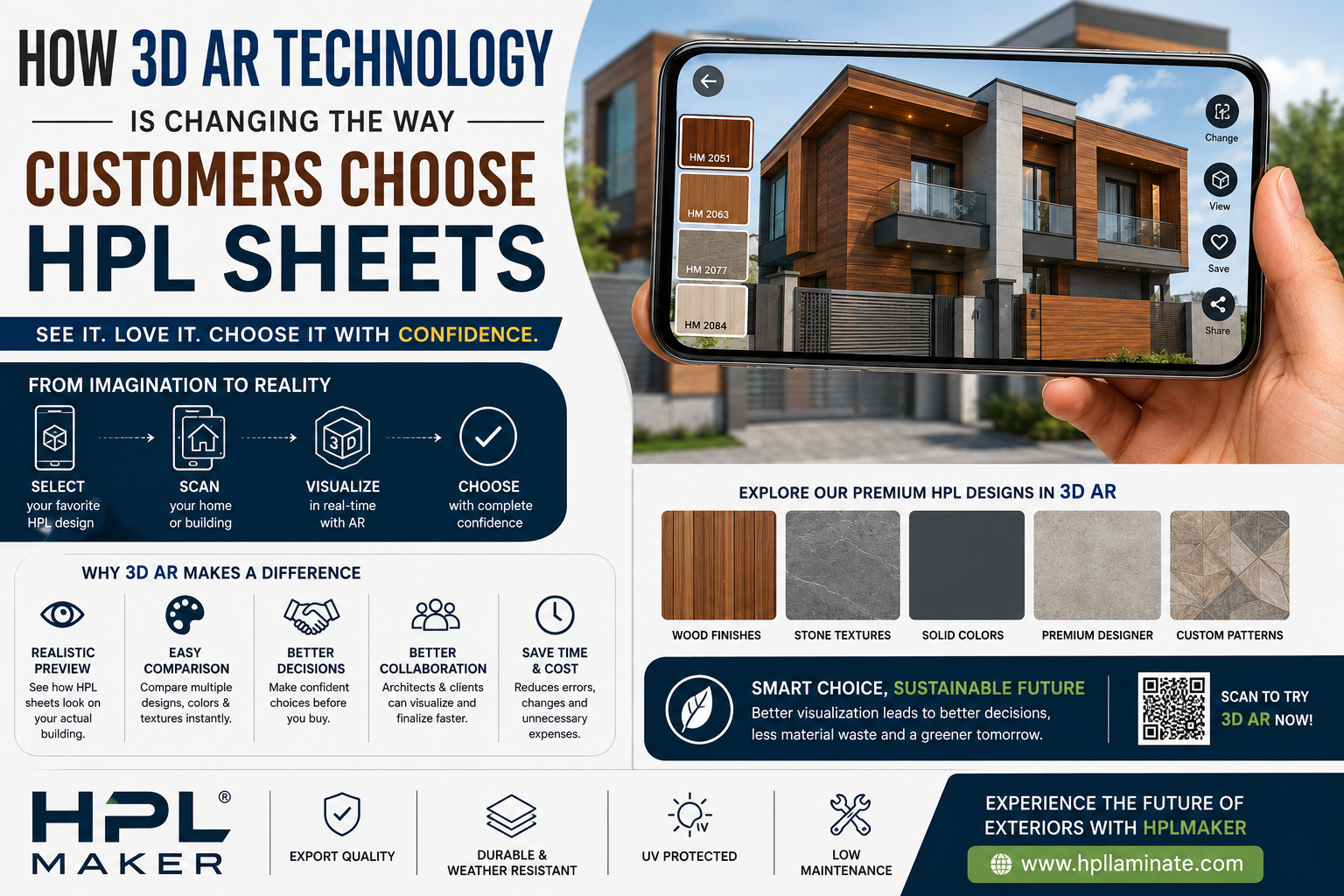
Today, architects, builders, and homeowners can visualize HPL sheets on actual buildings before making a purchase decision. This technology is revolutionizing how customers explore, compare, and select exterior cladding materials.
What Is 3D AR Technology?
Augmented Reality (AR) combines digital content with the real world.
Using a smartphone, tablet, or computer, users can place digital products into a real environment and view them from different angles.
In the HPL industry, 3D AR technology allows customers to:
- Visualize HPL sheets on building facades
- Compare multiple designs instantly
- Explore colors and textures in real-time
- View products from different perspectives
- Make informed purchasing decisions
Instead of imagining how a design might look, customers can actually see it before installation.
Why Traditional Product Selection Often Creates Problems
When selecting facade materials, customers usually rely on:
Small Physical Samples
A small laminate sample may not accurately represent how a design will appear on a large exterior wall.
Printed Catalogs
Printed images often vary from real-world lighting conditions.
Showroom Displays
Showrooms provide useful inspiration but cannot replicate every building design.
Guesswork
Many homeowners ultimately make decisions based on assumptions rather than realistic visualization.
These limitations can lead to uncertainty and hesitation during the buying process.
How 3D AR Technology Solves These Challenges
Realistic Visualization
AR technology allows customers to see how HPL sheets will appear on actual buildings.
This creates a far more accurate representation than traditional catalogs.
Customers gain confidence because they can evaluate:
- Colors
- Textures
- Design combinations
- Architectural compatibility
before placing an order.
Better Design Decision-Making
Choosing between multiple HPL designs can be difficult.
With AR technology, users can instantly switch between different options and compare them side by side.
This helps identify the design that best complements the architecture.
The result is a more informed and satisfying selection process.
Improved Customer Confidence
One of the biggest barriers to purchasing exterior materials is uncertainty.
Customers often worry about:
- Color mismatches
- Design compatibility
- Unexpected results after installation
AR reduces these concerns by providing a realistic preview before purchase.
When customers can visualize the final outcome, decision-making becomes easier.
Enhanced Collaboration Between Architects and Clients
Architects frequently spend significant time explaining design concepts to clients.
3D AR technology simplifies communication by providing visual demonstrations instead of relying solely on drawings and renderings.
Clients can immediately understand:
- Design intent
- Material placement
- Color combinations
- Overall facade appearance
This improves collaboration and accelerates project approvals.
The Growing Role of AR in Modern Architecture
Technology continues to reshape the architecture and construction industry.
Modern design professionals increasingly use digital tools for:
- Building visualization
- Design presentations
- Material selection
- Project planning
AR represents the next step in this evolution.
As customers become more comfortable with digital experiences, interactive visualization tools are expected to become standard across the building materials industry.
Benefits of AR for HPL Manufacturers
The advantages of AR technology extend beyond customers.
Manufacturers also benefit through:
Faster Sales Cycles
Visual confidence often reduces decision-making time.
Improved Customer Satisfaction
Customers are more likely to be satisfied when expectations align with final results.
Better Product Presentation
AR showcases products more effectively than traditional brochures.
Reduced Selection Errors
Customers can evaluate designs more accurately before purchasing.
These benefits create value throughout the entire sales process.
Why HPL Sheets Are Ideal for AR Visualization
HPL sheets are available in hundreds of design variations.
These include:
- Wood finishes
- Stone textures
- Solid colors
- Contemporary patterns
- Architectural designs
Because design plays such an important role in product selection, AR technology is particularly valuable for HPL applications.
Customers can experiment with multiple combinations without physically installing materials.
This creates a more engaging and informative buying experience.
HPLMaker’s Innovative 3D AR Experience
Recognizing the growing importance of digital visualization, HPLMaker has introduced advanced 3D AR technology to help customers explore HPL sheet designs more effectively.
Through its interactive AR platform, users can:
- View HPL sheets in 3D
- Explore multiple design collections
- Visualize facade concepts
- Compare textures and finishes
- Make more confident purchasing decisions
This technology helps bridge the gap between imagination and reality.
Instead of relying solely on samples or catalogs, customers can experience products in a far more realistic way.
Explore the interactive experience through the HPLMaker 3D AR Catalogue.
Sustainability Through Smarter Decision-Making
Technology can also contribute to sustainability.
When customers make more accurate material selections:
- Fewer design changes occur
- Product waste decreases
- Replacement requirements are reduced
- Resources are used more efficiently
Organizations such as the World Green Building Council continue to highlight the importance of efficient construction practices and responsible material use.
Digital visualization tools support these goals by helping projects make better-informed decisions from the beginning.
The Future of HPL Product Selection
The way people purchase building materials is evolving rapidly.
Future customers will increasingly expect:
- Interactive experiences
- Real-time visualization
- Digital product exploration
- Virtual design assistance
3D AR technology is becoming a key part of this transformation.
Manufacturers that embrace innovation will be better positioned to serve modern architects, builders, and homeowners.
Conclusion
The construction industry is moving beyond traditional catalogs and physical samples. Customers now want realistic, interactive experiences that help them make confident decisions before investing in building materials.
3D AR technology delivers exactly that.
By allowing users to visualize HPL sheets on actual buildings, AR improves design accuracy, enhances customer confidence, and creates a more engaging buying experience.
Through innovative solutions such as its 3D AR catalogue, HPLMaker is helping shape the future of product selection in the architectural materials industry.
As digital technologies continue to evolve, the ability to see before you build will become one of the most valuable tools in modern construction.